Showing posts with label Computer Hardware and Integrated Software. Show all posts

Sunday, February 14, 2010

Mouse


A Mouse is a computer device used for pointing that works by detecting two-dimensional motion that relates to its surface. It features two buttons, a cursor, and a wheel for movement. Its motion is reflected on a computer screens and so are the commands given on the mouse which allows Graphic User Interface. GUI is when interactions are made with people by more than just typing. The first dating of a mouse that came with a personal computer was in 1981 and commonly, a computer mouse would be connected to a computer through a USB (Universal Serial Bus). With today's advances in technology, a mouse can be connected through a USB port or it is wireless and a connection is established through the wireless frequencies in the mouse, and a receiver.

Network Drive


A Network Drive is when a hard-disk or a space is shared in a computer in which information is shared by different users through a server.

Non-Impact Printers


A Non-Impact printer is a printer that can produce images digitally or without making any impact and noise while doing so. These printers differ from impact printers because impact printers use mechanics to strike an image on a piece of paper. They are known for making matrix patterns and the main types of Non-Impact Printers are Laser Printers, Ink Jet Printers, and Thermal Printers.

Optical Storage Device


An optical storage device is a laser used on a spinning disk to store data. In order to do so, marks are made in patterns so that they are readable with light. An old example of an optical storage device is known as a microform. Microforms are small pieces of film or paper in which documents are stored and can be read. When using a microform, a document is reduced to about 25 times it's original size. Today there are other means of optical storage devices which are currently in the making.

Output devices


Output devices are devices that communicate results of data in processing system (computer) and make them visible to the outside world. Examples of output devices are speakers, headphones, the screen/monitor, and the printer.

Plotter


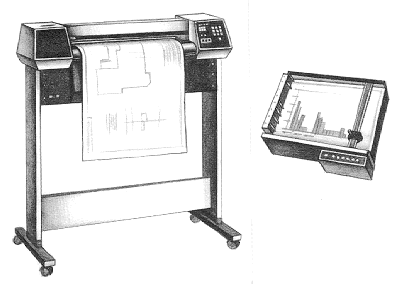
Plotters are printers that are used for printing graphics using point to point technology. Plotters are composed of pens and were used for color printing way before ink jet printers came to the scene. They are more affordable than other printers and offer the best resolution options unlike all other printers. Unlike common printing, anything printed on a Plotter will actually be drawn, instead of being printed in little dots.

Pointer


A pointer is an incorporated computer program which is used to open an address or another program on a computer.

RAM (Random Access Memory)


RAM (Random Access Memory) is a device used for computer storage. Ram is in the form of integrated computer circuits and is used for saving data that can be reused and modified unlike ROM (Read Only Memory). It is used in flash devices and can be saved in partitioned spaces which are portions of computer RAM.

ROM (Read Only Memory)


Rom (Read Only Memory) is a storage device that is used in computers and other devices. The data it contains is specific to the device that it is intended for, therefore ROM is memory that cannot be changed. Some modern types of ROM known as EPROM and EEPROM can be erased or reprogrammed, but after doing so, it cannot be changed. However it is very slow and sometimes it cant be saved to any memory location so as of 2007, it is rarely used.

Scanner


In the world of computers, scanners are mechanical objects used scan images, text, and handwriting, and then converts them to digital images which are transmitted to a computer. Scanners are usually flat objects in which the desired document is placed in a piece of glass and then scanned. Scanners have image sensors so that they are able to detect an object and convert it to an image.

System Time


System time is used in computers to represent all the time that has passed by since a specific points. These points are known as the Epoch, which is set to January 1st every year. In computers, system time is presented in the form of a clock or calendar. It's usually adjusted and set for leap years, and events such as Daylight Savings Time.